Infrastructure · Multi-cloud

Microsoft Azure is our home. AWS and Google Cloud are where we meet you when that is where you live.

We are a Microsoft Solutions Partner across five designations, with deep practice on Azure. We also design, deploy, and operate workloads on AWS and Google Cloud where customer environments call for it — including the AI services on each cloud: Azure AI Foundry, AWS Bedrock, and Google Vertex AI. Cross-cloud identity, network, and FinOps come from one accountable team, not three.

Five Microsoft Solutions Partner designations · Real AWS and GCP engagements · Cross-cloud identity, network, FinOps

Where we stand

Microsoft-first, not Microsoft-only.

Most of our depth is on the Microsoft stack — Azure, Microsoft 365, Copilot, Fabric, Entra, Sentinel. That is where we hold five Solutions Partner designations and where the bulk of our managed practice lives. But customer environments do not always live in one cloud, and pretending otherwise produces brittle architectures and resentful platform teams. Where AWS or Google Cloud is the right answer for a workload, we deliver there too.

The cloud decision belongs to the workload, not to the partner.

The three clouds

How we think about each cloud, and where our depth sits.

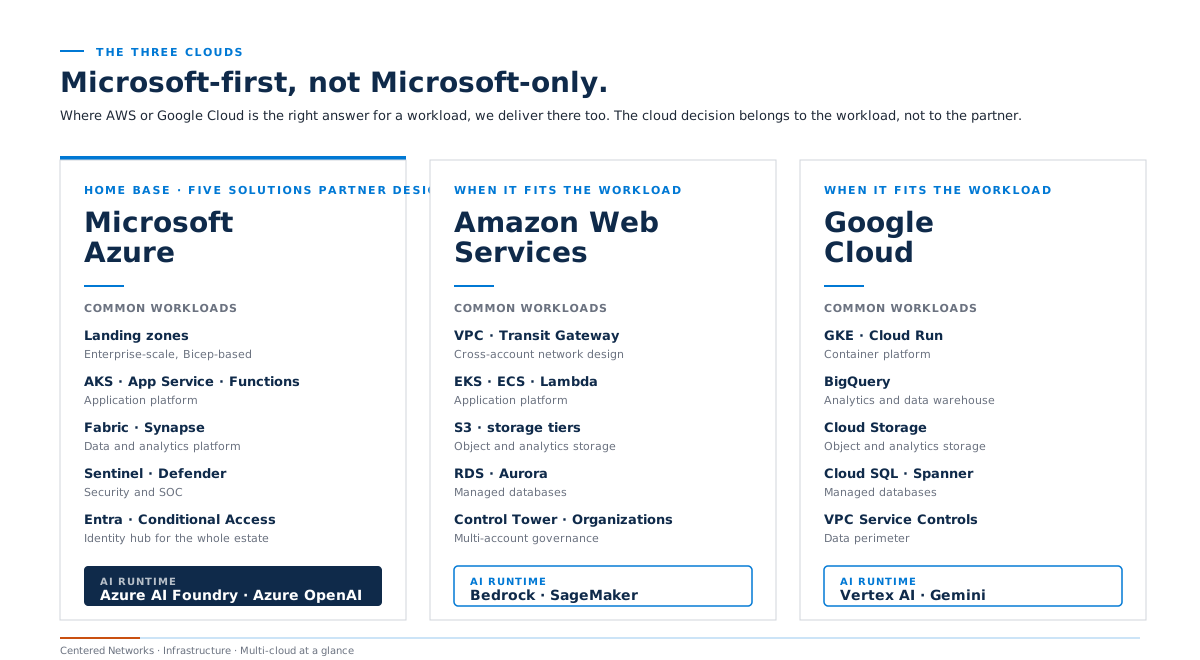
A three-column comparison of Microsoft Azure, Amazon Web Services, and Google Cloud. Azure leads with a Communication Blue top rule reflecting depth (five Solutions Partner designations), with AWS and GCP presented as peer columns. Each column lists six common workloads and names the AI runtime at the bottom: Azure AI Foundry, Amazon Bedrock, and Google Vertex AI.

Home base · Microsoft Solutions Partner

Microsoft Azure

Five verified Solutions Partner designations, including Infrastructure (Azure), Data and AI (Azure), and Digital and App Innovation (Azure). The deepest part of our practice.

Common workloads

  • Landing zones · Enterprise-scale and bicep-based
  • AKS, App Service, Functions · Application platform
  • Fabric and Synapse · Data and analytics platform
  • Sentinel and Defender · Security and SOC
  • Entra and Conditional Access · Identity hub for the whole estate
  • Azure AI Foundry, Azure OpenAI · AI and agent runtime

When it fits the workload

Amazon Web Services

Real engagements across networking, compute, storage, and data. Strongest fit when the customer estate is already AWS-native, when the application stack is built for it, or when a specific AWS service is the right answer.

Common workloads

  • VPC and Transit Gateway · Cross-account network design
  • EKS, ECS, Lambda · Application platform
  • S3 and storage tiers · Object and analytics storage
  • RDS and Aurora · Managed databases
  • Control Tower and Organizations · Multi-account governance
  • Bedrock and SageMaker · AI and ML runtime

When it fits the workload

Google Cloud

Real engagements, most often around data analytics, container platforms, and Gemini-based AI work. Strongest fit when the data platform is BigQuery-shaped or when an application is built around Google services.

Common workloads

  • GKE and Cloud Run · Container platform
  • BigQuery · Analytics and data warehouse
  • Cloud Storage · Object and analytics storage
  • Cloud SQL and Spanner · Managed databases
  • VPC Service Controls · Data perimeter
  • Vertex AI and Gemini · AI and ML runtime

AI on every cloud

Foundry, Bedrock, Vertex AI — we ship on all three.

Each hyperscaler has built a serious AI runtime. The right one depends on where your data lives, which models you need, what governance posture you operate under, and which sales agreement is already in place. We deploy on each and bridge across when the architecture calls for it.

A three-column comparison of the AI runtimes Centered Networks deploys on each hyperscaler. Azure AI Foundry is the lead column with a navy header reflecting the depth of practice; Amazon Bedrock and Google Vertex AI are peer columns. Each column lists what we ship, identity model, governance layer, and what each pairs with. Foundry is marked as where most of our AI work lives.

Microsoft Azure

Azure AI Foundry

The deepest part of our AI practice. Foundry is where most of our customer agent work, model deployments, and evaluation pipelines run.

What we ship

  • Azure OpenAI deployments with PTU or pay-as-you-go
  • Foundry Agent Service for multi-agent orchestration
  • Model catalog across OpenAI, Mistral, Llama, Phi
  • Prompt flow and evaluation harnesses
  • Content safety and PII guards on every endpoint
  • Entra-backed identity and Conditional Access

Pairs with

  • Microsoft 365 Copilot, Copilot Studio, Fabric

Amazon Web Services

Amazon Bedrock

First-class when the data, application, and security perimeter already live in AWS. Bedrock keeps the inference traffic inside the VPC and the IAM model the platform team already operates.

What we ship

  • Bedrock model access across Anthropic, Meta, Mistral, Cohere
  • Bedrock Agents with action groups and knowledge bases
  • Bedrock Guardrails for content and PII controls
  • SageMaker for fine-tuning and custom training
  • OpenSearch as the vector store
  • IAM Identity Center bridged to Entra where it fits

Pairs with

  • S3-resident data lakes, Lambda-based application code, RDS

Google Cloud

Google Vertex AI

The natural choice when the analytical center of gravity is BigQuery, or when Gemini and Google search grounding are the model and tools you actually want.

What we ship

  • Gemini deployments with regional grounding
  • Vertex AI Agent Builder for retrieval and tools
  • Model Garden across Gemini, Llama, Claude, Mistral
  • Grounding with Google Search for fresh retrieval
  • BigQuery ML and Vertex pipelines
  • VPC Service Controls for the data perimeter

Pairs with

  • BigQuery analytics, GKE-hosted applications, Cloud Run

None of these runtimes is the right answer for every workload. The honest version of "multi-cloud AI" is choosing one runtime per workload and operating each well. Foundry is where most of our work lives; Bedrock and Vertex AI are first-class when the surrounding cloud is. If the workload belongs on-prem, that lives here →

When to use which

A few of the signals we listen for.

These are heuristics, not rules. The real answer comes out of a workload conversation, not a vendor matrix.

Microsoft 365 is the productivity layer

Azure. Entra, Conditional Access, Copilot, Purview, and Sentinel form a single operating model around your users. AI workloads in Foundry inherit it.

The estate is already AWS-native

AWS. New AI workloads sit closer to the data and the IAM model they already operate under. Bedrock keeps inference inside the VPC. Bridging to Azure for identity or Microsoft 365 is fine, but compute belongs where the data lives.

The data center of gravity is BigQuery

Google Cloud. Vertex AI plus BigQuery ML keeps the analytics and the model in the same governance and billing boundary. Gemini grounding against your data sits adjacent.

Sovereign or regulated data with strict residency

Whichever cloud has the region with the right controls. Azure has the broadest US sovereign and government regions and the deepest commercial compliance posture. AWS GovCloud and Google Assured Workloads are first-class options for specific workloads.

A specific model is mandatory

The cloud that hosts it under the right terms. Anthropic Claude on Bedrock or Vertex. OpenAI on Azure. Gemini on Vertex. Llama and Mistral on all three. We help you pick the host that aligns with your data residency and contract.

Steady-state inference with sovereignty needs

On-prem GPU, bridged to a cloud for burst. Not a cloud decision — an architecture decision. See the AI infrastructure section on the Infrastructure page →

Cross-cloud operating model

Identity, network, and FinOps under one team.

The hardest part of multi-cloud is not deploying on three clouds. It is operating across them as one estate. We bridge the controls so your platform team has a single operating model, not three.

Identity bridge

Entra as the identity hub. SAML or OIDC federation to AWS IAM Identity Center and Google Cloud Identity. One source of truth for users, groups, and Conditional Access. Joiner-mover-leaver flows that touch every cloud at once.

Network design

Hub-and-spoke or transit-gateway designs that span clouds. Private connectivity (ExpressRoute, Direct Connect, Partner Interconnect) for sensitive traffic. DNS architecture that does not produce surprises when you cross a cloud boundary.

FinOps and cost visibility

Unified cost visibility across Azure, AWS, and GCP. Commitment management (RIs, Savings Plans, CUDs) sized against actual workload, not a vendor sheet. AI spend tracked separately because it behaves differently from infrastructure spend.

Posture and policy

Defender for Cloud across hyperscalers for unified posture. Tagging and policy standards applied consistently. Sentinel as the cross-cloud SOC where the security model calls for it.

Data movement and bridging

Cross-cloud data movement done sparingly and intentionally. Where workloads need shared data, the design pattern is documented — not improvised on a Friday afternoon.

One accountable team

The whole estate is one engagement, not three vendor relationships. When something breaks, the answer is not "call the other partner." We pick up the phone.

Talk to us about your cloud estate.

Whether you are landing your first workload in a second cloud, designing the AI runtime that belongs in your environment, or operating an estate that already spans Azure, AWS, and GCP, we will start from the workload and end with a design. No commitment beyond the conversation.

For on-prem and hybrid AI infrastructure, the conversation continues on the Infrastructure page.

  • Microsoft Solutions Partner, five designations
  • Real AWS and GCP engagements
  • No commitment to start
This field is required
Valid email required
This field is required

Thanks, we have it.

A senior cloud architect will reply within one business day about your scope.