Most boards we talk to treat shadow AI as a future risk: a thing to put on the agenda next quarter, once the policy refresh is done and the IT roadmap is updated. It is not a future risk. It is a present condition. The question is not whether the staff are already using ChatGPT, Claude, and Gemini outside the organization’s governance. They are, today, in nearly every nonprofit, foundation, and rural hospital we engage with. The only variable is the volume.
The interesting question is what you do about it once you know. The instinct to ban it does not work. The instinct to ignore it does not work either. The response that does work is more boring than either, and it begins with admitting that the staff are not waiting for the policy. They have already adopted the tools, made the data exposure, and formed habits the policy has not yet named. The work is catching up to where the organization already is.
What shadow AI actually looks like inside a 200-person foundation
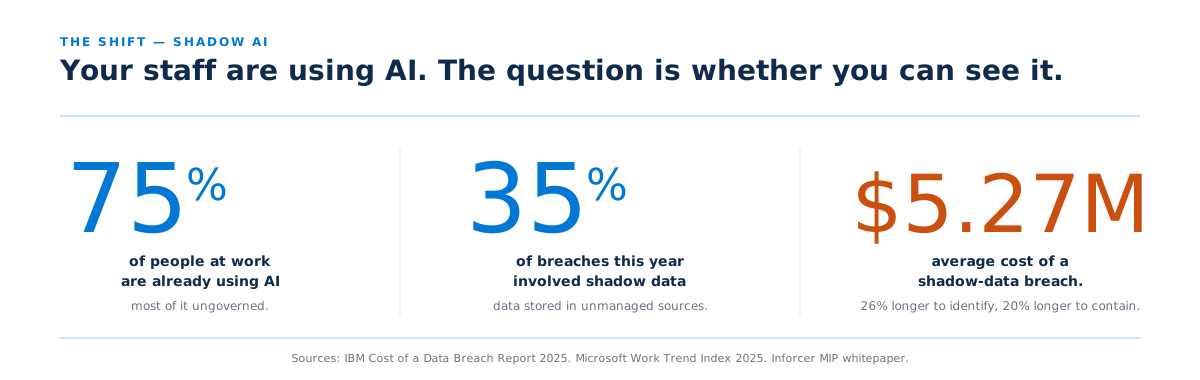
These are not hypothetical scenarios. They are present-tense field observations from the past twelve months of Discovery Sprints inside mission-driven organizations.
A development associate is drafting donor briefs in ChatGPT on a personal account. Donor names, giving history, and prior conversation notes, pasted into a tool whose default setting on a free-tier consumer account still permits prompt content to inform model behavior. The associate does not know about the toggle. Nobody told them. The briefs are excellent, and the executive director compliments the turnaround.
A program officer is using Claude.ai to summarize a stack of confidential grant reviews before a recommendation meeting. The reviews contain reviewer names, candid assessments of grantee leadership, and dollar figures that have not been disclosed externally. The summaries save four hours of reading. The program officer is delighted. The compliance officer has not been asked.
A communications lead is running every board email through Gemini for “tone polish” before it goes to the chair. The emails include strategic positioning, draft language about a planned reorganization, and one paragraph about a senior staff personnel issue. The lead is using a personal Google account because the work Google Workspace tenant does not have Gemini turned on for staff.
A finance assistant has uploaded the full operating budget spreadsheet (line items, salary bands, restricted-fund allocations) into a consumer AI tool to “ask questions about it” in plain English. The questions are good ones. The audit trail is non-existent. Six months from now, when the assistant takes a job at a peer foundation, the prompt history goes with them.
Each of these staff members is doing what every productivity blog and LinkedIn thought-leader told them to do this year. They are using the best tool available for the job. The organization has not given them a better one. So they used the one they had.
The three failure modes we see most often
Data exposure through personal accounts.
When a staff member uses an AI tool on a personal account, the organization has no audit trail and no termination control. There is no log of what was uploaded, no policy enforcement on what could be uploaded, and no way to revoke access when the person leaves. Their prompt history (which may contain donor lists, grant decisions, board memos, or HR notes) leaves with them. It sits in a personal account, indefinitely, accessible to whoever inherits that login. The organization cannot delete it because the organization cannot see it.
This is the failure mode that gets named in incident reports a year after the fact, after a former employee’s email is breached and the breach forensics reveal a prompt history that should never have left the building.
Inadvertent training-data contribution.
Most consumer AI tools have, at various points over the past two years, defaulted to using prompt content to inform model behavior. The defaults have improved: most providers now offer enterprise tiers that contractually exclude prompts from training, and the consumer defaults are clearer than they were. But the audit risk is unchanged: nobody in your organization can prove, on which date, with which tool, on which staff account, the opt-out toggle was set. That uncertainty is the exposure. A funder asking pointed questions about data handling will not accept “we think most of our staff probably opted out.”
The defensible position is not “we trust the vendor’s default.” The defensible position is “the tools our staff use are tenant-bound and contractually scoped, and we can produce the documentation.”
Strategy and reasoning leakage.
The data itself is not always the most sensitive part of a prompt. The reasoning is. When a program officer types “we are considering pulling funding from Program X because the leadership transition has not gone well and we are losing confidence in the executive director,” the most sensitive content is not the program name; it is the deliberative process behind the funding decision. That kind of strategic reasoning is the substance of foundation work, and it gets typed into ungoverned tools every day, in every organization we audit.
The thinking is what makes a foundation a foundation. Outsourcing the thinking to an ungoverned tool means outsourcing the thinking trail to an ungoverned tool. That is a posture no general counsel would sign off on if they were asked. They are not being asked, because the prompts are happening on personal devices, on personal accounts, at home, after hours.
Why “ban it” doesn’t work
The reflexive board response to shadow AI is a blanket prohibition. We have watched this fail inside mid-sized foundations within ninety days of the policy memo. The pattern is consistent. First, the policy goes out. Second, staff productivity drops measurably, not catastrophically, but the work product the board got used to in the prior six months is no longer arriving on the same schedule. Third, the staff who were the heaviest users quietly resume using the tools on personal devices, off-network, during off-hours. The ban displaces the usage; it does not end it.
The ban becomes a paper tiger. IT cannot enforce it on personal devices and home networks. HR cannot enforce it without surveillance that no mission-driven organization will tolerate. The legal exposure increases, because the policy now says one thing while the practice does another, and the gap between policy and practice is exactly what a funder, a regulator, or a litigant will want to surface in discovery.
Why “ignore it” doesn’t work either
The opposite instinct (wait until the dust settles, see how the market matures, address it next year) is materially more dangerous than it looks. The compliance and reputational exposure compounds with every quarter of unmanaged usage. The first funder due-diligence questionnaire that asks, “Describe your AI governance posture and the controls your organization has implemented for staff use of generative AI,” is going to land in an inbox without warning. The organization that cannot answer that question loses ground in the conversation that follows, and the conversation that follows is increasingly the one that determines whether the renewal gets signed.
The reputational version is worse. A single Form 990 attachment, audit finding, or local-press story about sensitive data being exposed through ungoverned AI usage will outlast the response. The board’s preferred posture (“we are watching the space carefully”) is not a defense when the question becomes “and what controls did you have in place?” The right time to put controls in place was a year ago. The second-best time is now, before the question arrives.
The choice isn’t between AI and no AI. It’s between governed AI and ungoverned AI. Your staff already made the first decision for you.
Meet the shadow usage with sanctioned, governed alternatives
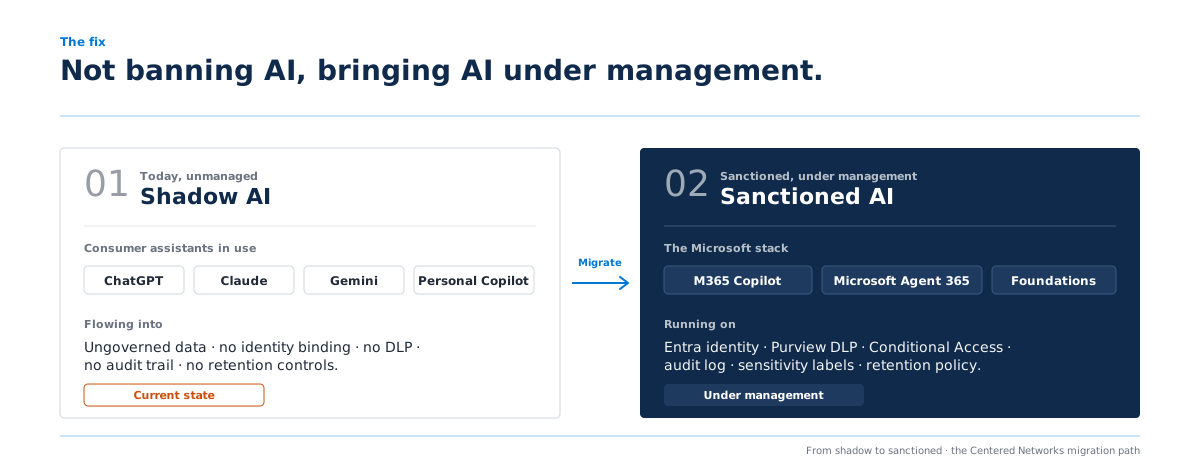
The response that works in the mission-driven sector is not “stop using AI.” It is “stop using the ungoverned tools, and here is the governed one we have given you, with training, with policy, with a help channel, and with the same general capability your shadow tool had.” The Managed Intelligence Provider model is built around exactly this substitution.
The Microsoft-native answer is more capable than most boards realize. Microsoft 365 Copilot Chat is included at no additional charge with most Microsoft 365 business licenses: it is a tenant-bound, enterprise-data-protected chat experience the staff can use today, governed under your existing identity and compliance posture, with no prompt content used for training and a clear audit trail. Microsoft 365 Copilot, the licensed product, extends that grounded experience into Word, Excel, PowerPoint, Outlook, and Teams. Copilot Studio lets you build the role-specific agents the staff actually want (the donor-brief drafter, the grant-review summarizer, the budget Q&A assistant) inside the governance perimeter rather than outside it.
The model is not “ban the bad tools.” The model is “redirect the staff energy that already exists toward the tools the board can defend.” Done well, the sanctioned alternative is a better daily experience than the shadow tool was, because it has access to the organization’s actual documents and context. Done poorly, it is just one more thing the staff have to log into. The difference is the rollout work, which is the same work covered in our previous field note on the seven questions every mission-driven board should answer before enabling Copilot.
The seven-day diagnostic question
Before the policy, before the rollout, before the board memo, there is a single piece of work that costs almost nothing and changes the conversation. Run an anonymous staff survey. Three questions, no follow-ups, no identifying fields:
- Which AI tools have you used for work tasks in the past thirty days?
- What kind of organization data have you put into them?
- What would you like to use AI for that you currently cannot?
The first answer tells you what is already in your environment. The second answer tells you what your real exposure is. The third answer is the most valuable: it is the rollout backlog, written by the staff, for free. We have run this survey in organizations that were “certain” their shadow AI usage was minimal and found that more than seventy percent of respondents were using at least one consumer tool for work tasks, with finance and donor data showing up in the second answer at rates that surprised every executive director who saw the result.
The data is almost always shocking. It is also exactly the data the board needs to make a real decision instead of a theoretical one.
What the response plan looks like once you have the data
With the survey in hand, the response plan is concrete and ordered:
- Deploy the sanctioned tool. A Microsoft 365 Copilot rollout, scoped against the survey’s third-answer use cases, with the governance work covered in the seven-questions piece. Start where the staff energy already is, not where the vendor roadmap suggests.
- Update the policy with realistic permitted-use language. Name the sanctioned tools, name the prohibited tools, and name the categories of data that may or may not be used in either. Vague policies fail. Specific policies hold.
- Publish a single-page approved-AI-tools guide for staff. One sheet, in plain language: “Use this for that. Do not use this for that. Ask here if you are not sure.” Most policy documents fail because the staff cannot find the answer they need in the moment they need it. A one-pager fixes that.
- Turn on continuous visibility through Microsoft Defender for Cloud Apps. The same Microsoft 365 licensing that supports Copilot can surface shadow AI tool usage on managed devices and networks. It will not catch everything (a personal device on a home network is still invisible) but it will narrow the unknowns to a manageable set and let the response stay current instead of going stale.
The four steps fit inside ninety days for most mid-sized organizations. They are exactly the kind of interdisciplinary work (identity, policy, training, monitoring) that the Managed Intelligence Provider model exists to handle, because no single in-house role owns the whole problem and the work is the same across every organization that does it well.
The shadow AI conversation tends to land on boards as a binary: allow it or forbid it. That framing is wrong. The staff have already chosen. The only choice the board still has is whether the AI happening inside the organization is governed or ungoverned. Both options have costs. Only one of them has a written answer for the funder, the auditor, the regulator, and the chair when the question finally lands.
The work to get from ungoverned to governed is short, scoped, and well-understood. It is not an overhaul. It is a substitution: a better tool, inside the perimeter, with the training and policy that make it defensible. That is the response we recommend, that is the response that holds, and that is the response that lets the conversation with the board stop being about risk and start being about value.
Want the controls in place? Secure & Govern Microsoft is where we start.