Position paper
The MIP: why the MSP category is ending and what replaces it.
A twenty-year arc closes. From break-fix, through managed services, MSSP, and the cloud-first MSP, the work has finally moved on. What replaces it is the Managed Intelligence Provider, and for mission-driven organizations, the difference is structural, not cosmetic.
In May 2026, the two largest AI labs in the world stood up standalone enterprise services firms. On May 4, Anthropic announced a $1.5 billion AI-native services firm with Blackstone, Hellman & Friedman, and Goldman Sachs. One week later, OpenAI launched its Deployment Company with $4 billion from TPG and nineteen co-investors, and absorbed the AI consulting firm Tomoro on the same day. Both are running the Palantir playbook for the model-vendor era: send technical teams into operating businesses, redesign workflows around agents, and stay embedded long enough to make the deployment actually work.
The pattern matters. So does the gap it leaves open.
What the announcements really told the market is that the MSP category which defined business IT for the last twenty years is ending. The work itself has moved. What replaces it is the Managed Intelligence Provider (the MIP) and for the nonprofits, foundations, and rural hospitals neither Anthropic nor OpenAI will reach, the question is no longer whether the model will arrive but whose version of it will get there first.
$5.5 billion in three weeks, validating one thesis.
May 4, 2026. Anthropic announces a $1.5B AI-native services firm with Blackstone, Hellman & Friedman, and Goldman Sachs. Co-investors include General Atlantic, Apollo, Sequoia, Leonard Green, and GIC. Target market: community banks, mid-sized manufacturers, and regional health systems.
May 11, 2026. OpenAI launches its Deployment Company with $4B from TPG and nineteen co-investors including Advent, Bain Capital, and Brookfield. Acquires Tomoro (~150 AI engineers) the same day. Target market: general mid-market enterprise.
Two firms. More than twenty institutional backers between them. One thesis, capitalized at $5.5B in twenty-one days: the future of enterprise AI is forward-deployed and managed, not licensed and self-served.
July 2, 2026. Microsoft names the model, and calls it a Frontier Company.
Weeks after the labs moved, the platform vendor at the center of the mission-driven stack said the same thing in its own words. Microsoft defined the organization that wins with AI as one that amplifies and protects its own intelligence, across three layers.
An Intelligence Platform: proprietary data and workflows compounding through AI. A Trusted Platform: governance, security, and cost control, so a customer’s IQ is never used to train someone else’s model. And the enterprise AI engineering to keep agentic processes improving as the models change every quarter.
That is the MIP deliverable, described by the platform vendor we build on. The category this paper names now carries Microsoft’s own language. Source: Microsoft, “Microsoft Frontier Company,” July 2, 2026.
Why the MSP category is ending.
Read the last twenty years of managed IT as four patterns, each a layer of professionalism on top of the last.
Break-fix, mid-2000s. A truck rolls when something breaks. The bill is hourly. There is no relationship and no posture, only events. The business is fundamentally reactive.
Managed services, 2010s. Flat-fee monitoring, patching, and helpdesk replaces the truck roll. Uptime is the SLA. The relationship is monthly. The whole category invents itself around predictability: predictable costs for the client, predictable revenue for the provider, predictable Tuesday-morning support tickets for both. The category names itself the MSP.
The MSSP overlay, late 2010s. Security stops being an add-on and becomes a co-equal layer. Endpoint detection, SIEM, and a SOC sit alongside the managed services contract. The smart MSPs build out an MSSP arm. The unsophisticated ones bolt on a third-party SIEM tool, call it managed security, and quietly hope a real incident never arrives.
The cloud-first MSP, 2020s. Microsoft 365 and Azure become the client’s actual operating environment. The work moves from racks in a closet to tenants in the cloud. The MSP’s competence shifts from servers to Entra, Intune, Defender, Purview, and the Microsoft 365 admin center. The contract still bills monthly, the SLA still names uptime, but the underlying skill set has been reborn.
Each step was a layer of professionalism on top of the previous one. The MIP is not the next layer. It is a different operating model.
The work has shifted from running infrastructure (a finite, mature, mostly-solved problem) to deploying and operating intelligence, which is none of those things. Models change quarterly. Governance requirements evolve continuously. Agent lifecycles need ongoing operation. None of that fits inside a 36-month MSP contract focused on uptime SLAs and ticket SLAs. The category that won the last twenty years was built around a different problem than the one in front of the buyer now. For a side-by-side view, see how the MIP compares to the traditional MSP, dimension by dimension.
The work has shifted from running infrastructure to deploying and operating intelligence. Models change quarterly. Governance evolves continuously. None of that fits inside an uptime SLA.
What an MIP actually is.
The category was named by the MSP industry analysts at Pax8 and Inforcer, who began publishing the Managed Intelligence Provider thesis in late 2025. The label is theirs. The structural definition that follows is the one the market is now converging on.
An MIP is recognizable by five characteristics, not by a marketing claim.
- Managed intelligence as a primary deliverable, not a tail engagement. Agents need lifecycle management. Tokens need cost monitoring. Governance posture evolves with the underlying models. Drift gets detected and corrected. Compliance gets attested continuously. This is monthly billing, quarterly governance review, and a delivery manager who owns the relationship, not a project that ended last quarter and a support inbox that ignores it.
- A productized engagement model with Assess, Deploy, and Operate as a defined sequence, not a custom SOW for every client. A fixed-fee assessment is the front door. A fixed-scope deployment is the middle. Ongoing managed operations are the steady state. Buyers know the scope, the duration, and the deliverable, and see the fee in writing, before they sign. Generic consulting cannot.
- Vendor-aligned but client-loyal. Deep alignment with one platform buys integration depth, governance simplicity, and pricing economics the client could not access alone. The right to deploy outside that platform when a specific workflow demands it protects the client from lock-in. The MIP picks a side on platform and stays on the client’s side on outcomes.
- Vertical specificity as a moat. The generalist services firms (Anthropic’s, OpenAI’s, Accenture, Deloitte) accumulate horizontal scale across industries. A vertical-specific MIP accumulates sector knowledge instead: how nonprofits are funded, how foundations are governed, what HIPAA looks like for a Critical Access Hospital, what an OMB Circular A-133 audit actually reads. That knowledge compounds in a way horizontal scale does not.
- Structural terms, not statements of intent. Fixed prices, fixed durations, and month-to-month commitments published in plain language, with every artifact yours to keep. The opposite of the open-ended consulting SOW where the price is “time and materials” and the duration is “until the budget runs out.”
Each of these is observable from the outside. A buyer can read a website, an SOW, and a price sheet and tell whether a firm is an MIP or an MSP that put “AI” on its homepage. The category is not aspirational. It is structural.
The category is structural, not aspirational. A buyer can read an SOW and a price sheet and tell which side of the line a firm sits on.
Why mission-driven organizations need an MIP specifically.
Read the targeting language of the two big announcements again, carefully. Anthropic’s firm is aimed at community banks, mid-sized manufacturers, and regional health systems. OpenAI’s is aimed at general mid-market enterprise. Both sit below the Accenture and Deloitte tier (the segment the large systems integrators have chronically underserved) and both will reach a customer base that can absorb $250,000 to $2 million in AI services spend without flinching.
That is not the mission-driven sector. A 40-person community foundation cannot absorb a $1M consulting engagement. A 25-bed Critical Access Hospital cannot absorb it. A 200-person human services nonprofit running on the donor relationships of three program officers cannot absorb it. The economics of the firms Anthropic and OpenAI just launched do not bend down to mission-driven scale, and pretending otherwise wastes time and budget on both sides of the table.
The structural reasons go deeper than headline price. Mission-driven organizations have:
- Small in-house IT and zero in-house AI talent. The work cannot be assembled out of internal staff hours. It has to arrive as a managed service or it does not arrive at all.
- Board scrutiny on every new vendor. Foundation boards govern, hospital boards govern, nonprofit boards govern. A new partner has to be defensible at the board level, with a credentials story, a governance story, and a price story that survives a finance-committee read.
- Funding cycles that do not permit surprise consulting invoices. Grant-funded budgets and donor-restricted funds do not absorb scope creep. Predictable monthly cost is not a preference; it is a procurement requirement.
- Regulatory weight unequal to staff size. HIPAA for a 25-bed hospital. OMB Circular A-133 for a federally-funded nonprofit. Donor-data fiduciary duty for a foundation. The compliance burden does not scale down with the organization, and neither does the cost of getting it wrong.
The MIP’s monthly-billed, structurally-promised, continuously-operated model is the commercial structure that matches this reality. Project consulting firms do not fit. License resellers do not fit. The forward-deployed services arms of the AI labs do not fit. The gap is the most important thing in this story, and it is not a market failure. It is a market opening.
What separates a real MIP from a pretender.
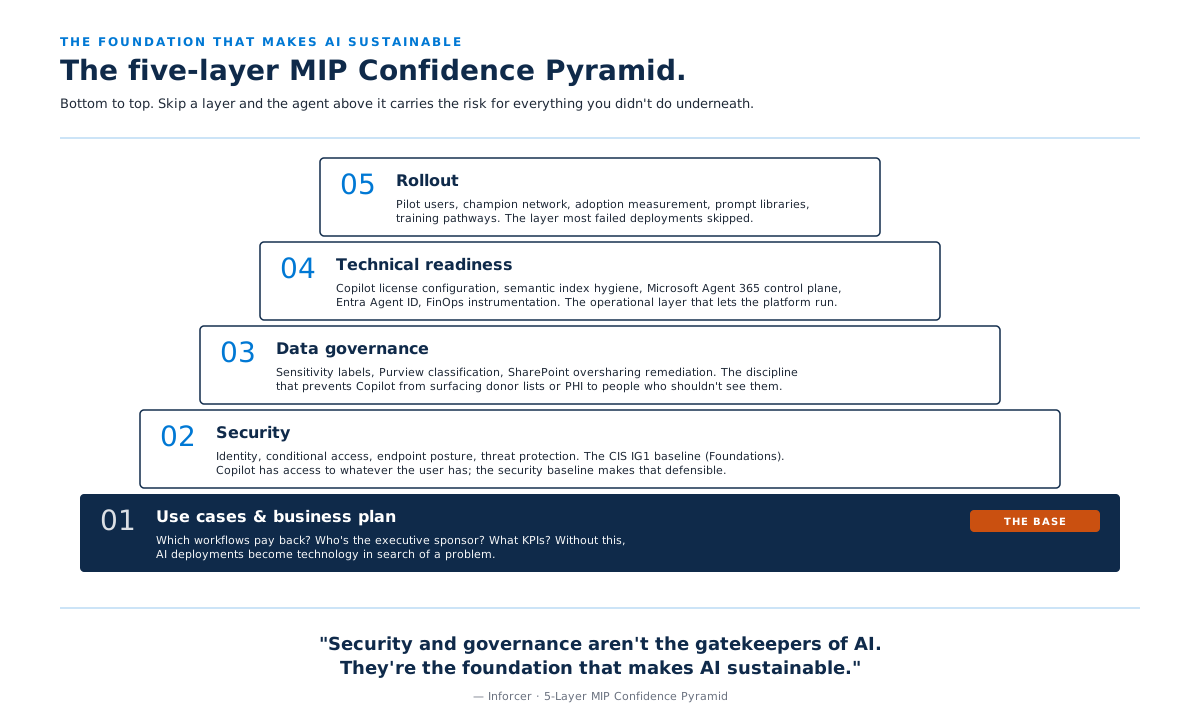
The label is going to be claimed widely over the next eighteen months. Every MSP with a Copilot tab on its website will discover that “Managed Intelligence Provider” sounds better in a Tuesday-morning sales meeting than “Managed Services Provider with an AI slide deck.” A buyer cannot rely on the label. The structure underneath the label is the most useful signal.
Five questions a board chair or rural-hospital CIO can ask any prospective partner. The answers do the diagnostic work the label cannot.
Is the price structure published, and is every fee confirmed in writing before kickoff?
A real MIP publishes how it prices: what is fixed, what recurs, and what Microsoft bills directly. Where a price is standard, it is on the website with a duration attached. Where scope genuinely varies, the fee is confirmed in writing before anything is committed, and the page says so. A pretender quotes everything as “contact us for a custom proposal,” with no point at which the price becomes firm. The tell is not whether every number is public. It is whether you get a fixed fee in writing before you commit.
Are the commercial terms structural and in plain language?
“We will work hard” is not a promise. “Month-to-month on the managed services, 30 days’ notice, a stated minimum where one applies, and you keep every artifact we build” is a promise. Real MIPs publish their prices and their terms on the same page, in plain language. Pretenders bury accountability inside an MSA whose remedies clause says “reasonable commercial efforts.”
Is there a continuous-operations capability, or is “managed” just a synonym for “support tickets”?
An MIP runs a managed-operations team that monitors agent health, attests governance posture quarterly, tracks token cost month over month, and updates baselines when Microsoft ships a new model. A pretender has a ticketing system. Ask to see the cadence of the quarterly governance review and the named role of the person who runs it. If the answer is vague, the capability is not there.
Is there vertical depth in your sector, or are you the experiment?
Generalists will tell you they have “experience across many industries.” A vertical-specific MIP will instead tell you the name of the foundation, hospital, or nonprofit whose engagement is most similar to yours, and will offer a reference call. Sector vocabulary surfaces in the first thirty minutes of conversation. If your prospective partner does not know the difference between an FQHC and a Critical Access Hospital, or between a private foundation and a community foundation, you are the experiment.
Is the partner deeply aligned with a primary AI platform?
Vendor depth buys economics the client cannot access alone: nonprofit Microsoft licensing, Solutions Partner co-investment funding, preferential pricing on Microsoft 365 Copilot SKUs, early access to Microsoft Foundry features. A partner without that depth is reselling at retail, and the client absorbs the markup. Ask which Solutions Partner designations the firm holds, and ask which co-investment programs the engagement is eligible for. The answers are public.
These five questions are not a marketing checklist. They are the buyer’s side of the conversation, and they sort the category in about twenty minutes.
Centered Networks’ MIP.
Centered Networks is an MIP purpose-built for mission-driven organizations on Microsoft 365 and Azure. The structure is published. Prices are published where the scope is fixed: Microsoft 365 InstantOn is $15,000 to launch and $2,500 a month per module to operate; Managed AgentOps is $500 to $1,500 per agent per month, plus 15% of Copilot Studio consumption; Copilot Kickstart is $15,000; the Azure Well-Architected Review is $7,000 flat; and the InstantOn Readiness Assessment is $1,950, credited in full toward the Launch if you proceed. Every other fee is confirmed in writing before kickoff. The commitments are structural.
The Centered AI Practice is the productized path from decision to operations: the 90-Day AI Roadmap establishes priorities, then Copilot Kickstart or Agent Launchpad delivers the work the roadmap identifies, Frontier Transformation scales it when the evidence supports scaling, and Managed AgentOps operates what reaches production. Each engagement has a defined scope and outcome. The paths branch; there is no ladder every organization has to climb in order.
The CompleteCare architecture is the seven-tier managed-services spine the AI Practice runs on top of: Foundations, Govern, Automate, Insight, Construct, Intelligence, and Shield. Five Microsoft Solutions Partner designations, including Data & AI, sit underneath all of it. The Open Repo Promise keeps every agent, policy, and runbook in the client’s tenant, under the client’s ownership, with month-to-month exit on the managed engagement.
Pax8 and Inforcer named the MIP category. Centered Networks built it for the sector the AI labs and the global integrators will not reach.
Pax8 and Inforcer named the category. We built it for the sector the AI labs and the global integrators will not reach.
Two ways in.
The 90-Day AI Roadmap is the diagnostic. The Frontier Briefing is the board-level conversation. Most engagements begin with one or the other. For the commercial version of the argument on this page, how Centered Networks actually delivers Managed Intelligence, see the Managed Intelligence operating model.
Get your 90-Day AI Roadmap.
A focused, paid engagement of about two weeks. We assess your Microsoft 365 environment, name the right starting tier, and deliver a 90-day roadmap your board can act on.
Get your 90-Day AI RoadmapRequest a Frontier Briefing.
A private 90-minute session on the Managed Intelligence Provider model and what it means for your organization. Built for boards and executive teams that need to align before procurement begins.
Request a Frontier Briefing →