Knowledge agents
Retrieve, synthesize, and explain trusted organizational information for staff, boards, partners, or customers.
AI agents and automation
Centered Networks finds the workflows worth handing to an agent, builds production agents and automations on the Microsoft platform, connects them to approved knowledge and systems, and puts human judgment where the work requires it.
Three minutes, no email.
About two weeks, from $7,500.
Microsoft solution area: AI Business Solutions
Build around work, not demos
The better question: which work is repetitive enough, valuable enough, and governable enough to deserve one?
We prioritize workflows where an agent can create meaningful capacity without introducing more complexity than it removes.
Common agent patterns
Most agents assist and prepare work for people. Some act within defined controls. The default progression is assist → prepare → act with controls, not autonomy for its own sake.
In your organization, that might look like:
Retrieve, synthesize, and explain trusted organizational information for staff, boards, partners, or customers.
Classify requests, gather context, route work, and prepare the next action for a person or system.
Collect information, summarize evidence, prepare drafts, and reduce the time before a human decision.
Coordinate multi-step work across Microsoft 365, Power Platform, approved APIs, and line-of-business systems.
Assemble recurring operational information, identify exceptions, and prepare leadership-ready updates.
Support a specific department or function with a tightly scoped purpose, data boundary, and owner.
Document the business outcome, owner, inputs, outputs, success measures, and actions the agent is allowed to take.
Identify the Microsoft 365 content, structured data, APIs, and tools the agent can use, and what it must never access.
Use Copilot Studio, Power Platform, Microsoft Foundry, Azure, and approved integrations based on the workflow.
Test quality, grounding, permissions, edge cases, failure behavior, and business acceptance before production deployment.
Require approval for high-impact, external, financial, sensitive, or irreversible actions where the process demands it.
Launch with an owner, environment, telemetry, support path, and criteria for expansion or retirement.
Microsoft platform
Centered Networks uses the Microsoft platform to minimize unnecessary seams. Technology choice follows the workflow, governance needs, and operating model, not a desire to force every problem into the same tool.
Microsoft Solutions Partner with five designations, including Data & AI. We helped design and build the National Mall Gateway on Microsoft Azure for the Trust for the National Mall.
Human-in-command by design
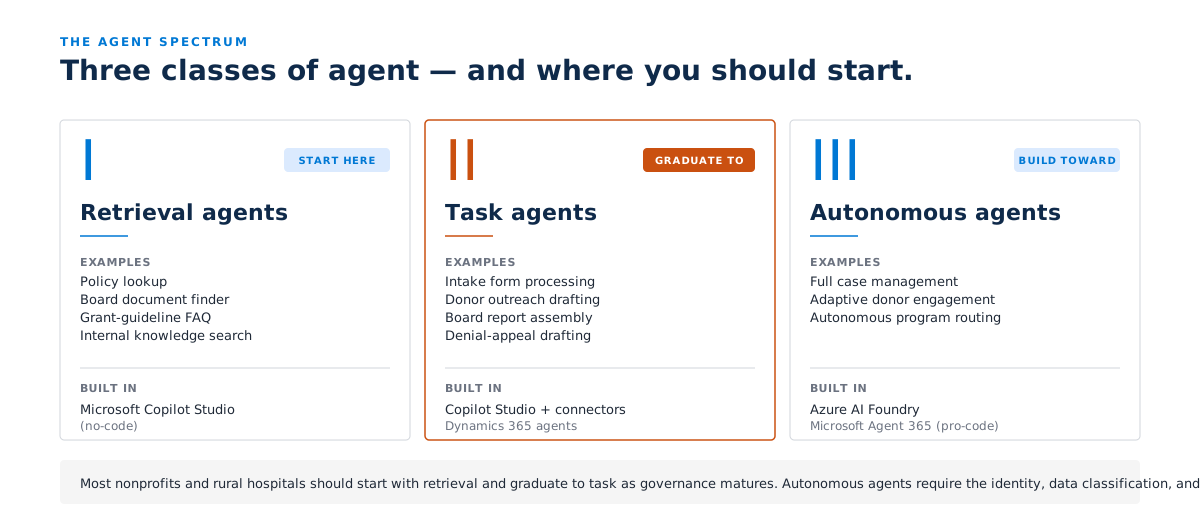
Three classes of agent, and where you should start.
I Retrieval agents Start here
Policy lookup, board document finder, grant-guideline FAQ, internal knowledge search.
Microsoft Copilot Studio (no-code).
II Task agents Graduate to
Intake form processing, donor outreach drafting, board report assembly, denial-appeal drafting.
Copilot Studio with connectors, and Dynamics 365 agents.
III Autonomous agents Build toward
Full case management, adaptive donor engagement, autonomous program routing.
Microsoft Foundry and Microsoft Agent 365 (pro-code).
Most nonprofits and rural hospitals should start with retrieval and graduate to task as governance matures. Autonomous agents require the identity, data classification, and responsible-AI foundations.
Agents can prepare, recommend, retrieve, convert, and in some cases act. The right degree of autonomy depends on the consequences of a mistake.
The objective is not maximum autonomy. It is the right autonomy for the risk and value of the workflow.
After the first build
Once agents multiply, organizations need inventory, ownership, identities, policy, cost controls, runtime protection, lifecycle, and performance management.
That is why every production build should have a path into Managed Intelligence rather than becoming another abandoned automation.
Bring the process, the pain point, and the desired outcome. We will determine whether an agent is the right mechanism, then build one governed production agent around it.
See Agent LaunchpadStart with a workflow opportunity assessment inside the 90-Day AI Roadmap. A paid engagement of about two weeks.
Get your 90-Day AI RoadmapSkip “build another one.” Start by bringing the current estate under command.
See Managed AgentOpsThe Opportunity Finder points to the workflow worth starting with in three minutes. The 90-Day AI Roadmap turns it into a written plan: the dependencies to handle first and the controls each build should carry.
The Finder takes three minutes and asks for no email. The Roadmap is a paid engagement of about two weeks.