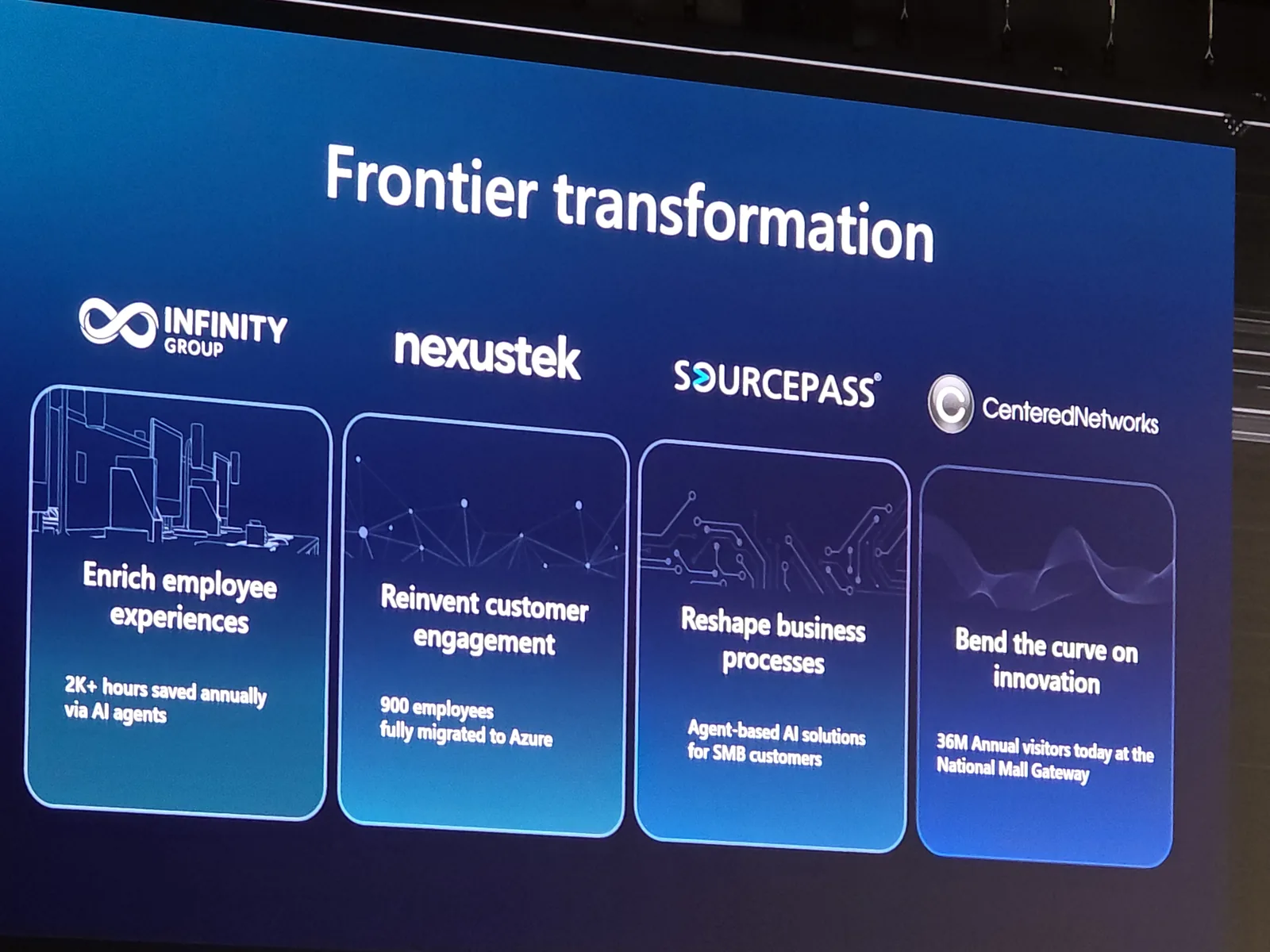
I am writing this from Pax8 Beyond 2026, and I am still a little stunned by the morning. During the main keynote, in front of the room, Microsoft’s Chief Partner Officer, Nicole Dezen, put up a slide titled “Frontier transformation” and named four partners on it. One of them was us. Centered Networks, on the main stage, called out by Microsoft as a leading Frontier partner, next to Infinity Group, NexusTek, and Sourcepass. The panel under our name read: “Bend the curve on innovation. 36M annual visitors today at the National Mall Gateway.”
For a firm our size, focused on a sector the industry usually treats as an afterthought, that is not a small thing. So I want to do two things in this post. First, explain what “Frontier” actually means, because it is a real Microsoft concept and not just a keynote adjective. Second, be honest about why we earned the slide: we made ourselves the first customer. We run AI on Centered Networks before we ever bring it to yours.
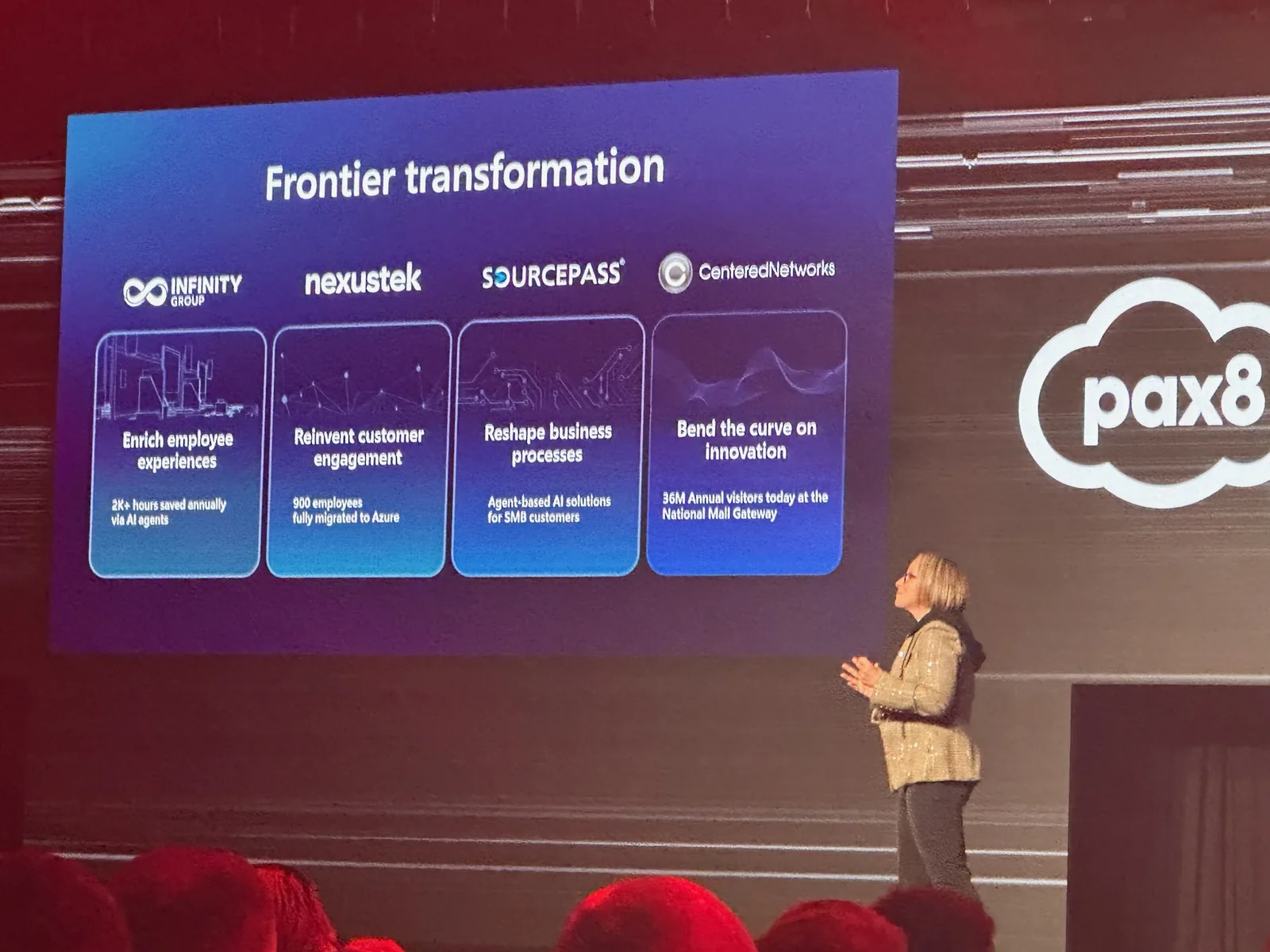
What “Frontier” actually means
Microsoft has been using a specific term for what comes after the productivity-tool era of AI: the Frontier Firm. The idea is straightforward, even if the implications are large. A Frontier Firm is an organization that has stopped treating AI as a feature bolted onto a few apps and started reorganizing the actual work around it. Intelligence becomes something you can call on demand. Agents take on whole workflows, not single keystrokes. And every person on the team is, in effect, managing a small set of digital coworkers alongside the human ones.
The distinction matters because most organizations are not there. They have a Microsoft Copilot (formerly Microsoft 365 Copilot) license switched on for a handful of staff, a few people pasting work into a consumer AI chat tool, and no shared sense of where the agents are, what they are allowed to touch, or who owns the output. That is not a Frontier Firm. That is shadow AI with a logo on it.
Becoming Frontier is a deliberate change. It means agents with their own governed identity, data that is labeled and access-controlled so the agents only see what they should, a real responsible-AI policy with named permitted and prohibited uses, and a way to measure whether the work is actually getting better. Microsoft is now shipping the platform pieces that make this possible: per-agent identity in Entra, inline governance in Purview, and the agent-management layer that ties it together. The platform is real. The hard part is the operating discipline around it, and that is the part Microsoft was pointing at when it put four partner names on that slide.
Why we earned the slide: the National Mall Gateway
The line under our name on that slide pointed to a single piece of work: the National Mall Gateway, which we built for the Trust for the National Mall on Microsoft Azure. In a typical year, 36 million people visit the National Mall, and in 2026, the United States’ 250th anniversary, that number is expected to climb toward 50 million. The Gateway is how a meaningful share of them now experience “America’s front yard” before they ever set foot on it.
That project is a mission-driven nonprofit doing something at genuine scale on modern cloud and AI infrastructure. It is exactly the “bend the curve on innovation” story Microsoft wanted on the slide, and it is the proof that the mission-driven sector does not have to settle for the slow lane. But it is not the whole reason we got there. The deeper reason is how we work on ourselves first.
Customer zero: we run the AI on ourselves first
Here is the part I most want mission-driven leaders to take from this post. We do not sell AI we have not lived with. Centered Networks is our own customer zero. Every agent, every governed workflow, every piece of the Frontier operating model we recommend to a foundation or a rural hospital, we stand up inside our own tenant first, on our own data, with our own people, and we keep it running long enough to learn where it breaks.
That is not a slogan. It is a discipline, and it changes what we are able to tell you:
- We have already paid the tuition. When an agent over-reaches, when a sensitivity label is missing and the agent surfaces something it should not, when the output review loop is the bottleneck rather than the model, we have hit those walls on our own time, not on your tenant during a board meeting.
- We can show you the real economics. Production AI is not free, and the token bill is real. We have watched our own usage curve, so when we talk about what a workflow costs to run at scale, it comes from our invoices, not a vendor estimate.
- We recommend the boring governance first because we needed it ourselves. Labels, conditional access, a written charter, a named human who owns review, a kill switch a person can flip in five minutes. We did not learn to value those from a slide. We learned it by running agents against our own business.
This is also why I started AutoGrant as a separate company: the next useful wave of AI is vertical, teams of specialized agents built for one domain, and the only honest way to build those is to run them in production yourself before you ask anyone else to.
What this means for mission-driven organizations
Microsoft writes for the median enterprise. The Frontier Firm framing, as published, is pitched at companies with a CISO, a data team, and a budget for all of it. The translation into the language of a 200-person foundation, a critical-access hospital, or a regional nonprofit is the work we do. The keynote slide was a signal that the translation is landing, that a firm built specifically for this sector can do Frontier-grade work and have Microsoft point at it on the main stage.
So if you lead a mission-driven organization and the word “Frontier” sounds like something for companies ten times your size, I would gently push back. The Gateway was built for a nonprofit. The customer-zero discipline exists precisely so that the path is de-risked before you walk it. You do not have to be first. You have to be ready, and getting ready is a defined, fundable piece of work.
Where to start
If today’s news makes you want to figure out where your organization actually sits, there are three honest entry points.
- A Frontier Briefing is a private 90-minute, board-level session that gives your leadership a shared vocabulary for governed AI and an honest read on where you are today.
- The 90-Day AI Roadmap is a focused paid engagement that maps your Microsoft environment, names the right starting point, and delivers a written 90-day plan.
- A Frontier Transformation is the productized, fixed-fee engagement that takes you from where you are to a working Frontier operating model: production agents live, an AI Center of Excellence operational, and a board-level dashboard to prove it.
Standing in that room this morning, watching our name go up next to firms many times our size, the thing I kept thinking was that the mission-driven sector earned a place on that slide too. We intend to keep earning it, the same way we got here: by being our own first customer, and bringing you only what we have already trusted with our own work.
If you want to understand the model behind all of this, the Managed Intelligence Provider position paper lays out why the old MSP category is ending and what replaces it.
Ready to scale past one pilot? Frontier Transformation moves an organization from isolated AI wins to a governed operating model in 90 days. Prefer to talk first? Talk to us.
Not sure which step fits? The Opportunity Finder takes three minutes and asks for no email.