CompleteCare05

Get the custom application your mission actually needs. Built on Azure. Native to your Microsoft 365 tenant. Never stranded.

Custom Azure application development for nonprofits: donor portals, grant management, custom case management, program tracking. Built right, then operated.

The Mission-Aligned Build™: fixed-scope Discovery, signed-off Azure architecture, agile MVP build with native Entra ID and Purview integration, 60-day Hypercare, and ongoing managed enhancement so the application never strands. Twelve to twenty weeks from Discovery to production.

Microsoft Solutions Partner for Digital & App Innovation (Azure) The Mission-Aligned Build™ The No-Lock-In Promise™ Microsoft FY26 co-sell: Build and Modernize AI Apps

Sometimes the workflow your mission needs does not exist as software.

The off-the-shelf donor CRM does not match how your foundation actually runs grantmaking. The generic case-management tool does not fit your program model. Power Platform can carry a lot of workflows beautifully, but not this one.

Most mission-driven organizations that have gone the custom route ended up with a stranded application: SSO bolted on rather than native to Entra ID, Purview sensitivity labels not honored, sitting outside the Microsoft 365 fabric the rest of the organization lives in, and abandoned when the developer relationship ended.

Bending the mission to fit a generic SaaS product is the wrong direction. Hiring a dev team in-house is not an option for most mission-driven organizations. Generalist dev shops do not understand the Microsoft ecosystem or the mission context: once the build is delivered, they hand you a codebase and a problem.

The pattern needs to break.

The Mission-Aligned Build™

Custom application development, fully operated. Never stranded.

CompleteCare Construct is the custom-application tier of the CompleteCare stack. The methodology covers Discovery, Architecture sign-off, Agile MVP Build, testing, Security Review, Production Deployment, 60-day Hypercare, and managed enhancement afterward.

Discovery and UX first. Stakeholder interviews, journey mapping, wireframes, and a clickable prototype you can walk before code is written. We answer the diagnostic question honestly: SaaS, Power Platform, or custom Azure? If custom is not the right answer, Construct stops here.

Architecture signed off as a gate. Azure architecture document (App Service, Functions, SQL or Cosmos DB, identity via Entra ID, integration plan with Microsoft 365 and other systems, security and observability design) reviewed and signed off before code is written.

Agile MVP Build. Two-week sprints with demos throughout. Microsoft 365 and Entra integration built in from sprint one. Purview-aware labeling where data sensitivity warrants.

Testing as a discipline. Functional, security (OWASP-aligned), accessibility (WCAG 2.1 AA), performance, and client-led User Acceptance Testing with documented acceptance criteria.

60-day Hypercare after launch. Daily monitoring, priority issue response, reserved sprint capacity for early-discovery fixes, weekly product-owner check-ins. Included in the Kickoff Project.

Managed enhancement afterward. Monthly Retainer plus Enhancement Pods so the application keeps evolving with the Microsoft platform.

Where Construct fits

The custom-app maturity model.

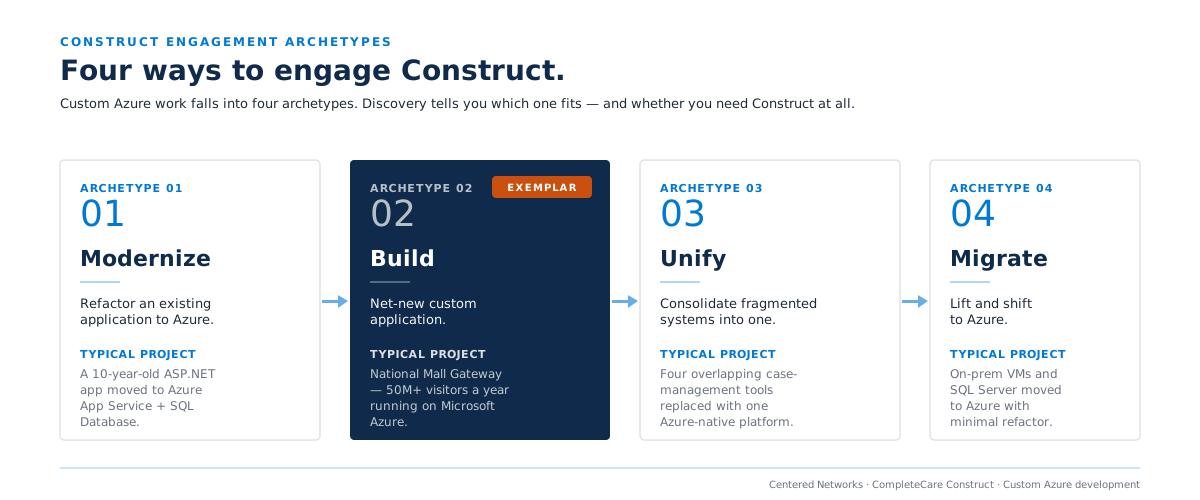
Four horizontal engagement archetypes for CompleteCare Construct—Modernize, Build, Unify, and Migrate—each with a one-line description and typical project, with the Build archetype highlighted by a National Mall Gateway exemplar badge.
Custom application maturity model: four stages from off-the-shelf SaaS to managed Azure app portfolio, showing where CompleteCare Construct applies.
Stage What it looks like How Construct relates
Stage 1: Off-the-shelf SaaS Generic CRM, generic grant tool, generic volunteer portal. Fast to start; rigid to fit. Not Construct. If SaaS fits, use it.
Stage 2: Low-code / Power Platform Power Apps and Power Automate handle a workflow off-the-shelf could not. Not Construct. That is CompleteCare Automate.
Stage 3: Custom Azure App (MVP) Pro-code application on Azure App Service, Functions, SQL or Cosmos. Native Microsoft 365 integration. This is the Construct Kickoff Project. 12 to 20 weeks. You are here if you have ruled out SaaS and Power Platform.
Stage 4: Managed Azure App Portfolio One or more production custom applications evolving over time. Steady-state Construct: retainer plus Enhancement Pods.

What is delivered

Ten named components covering the full lifecycle.

From Discovery through Annual Architecture Review, every stage is a named deliverable with defined acceptance criteria.

01

Discovery & UX Sprint

Stakeholder interviews, user-journey mapping, requirements definition, wireframes, and a clickable prototype the client can walk before code is written. Documented requirements artifact and approved UX direction. Delivered in weeks 1 and 2.

02

Architecture design

Azure architecture document: App Service, Functions, SQL or Cosmos DB, Storage, identity via Entra ID, data model, integration plan with Microsoft 365, security and compliance design, observability via Application Insights. Signed off before MVP build begins.

03

Agile MVP Build

Core feature build in two-week sprints, deployed to your Azure tenant. Entra ID for SSO and access control. Microsoft Graph where Microsoft 365 data is consumed. Purview sensitivity labels honored where warranted. Sprint demos throughout.

04

Microsoft integration (Entra / Microsoft 365 / Purview)

Native, not bolted on. SSO via Entra ID, role assignment via Entra security groups, file storage interoperating with SharePoint, Teams app surface where it adds value, and Purview-aware sensitivity labeling on application-managed data.

05

Testing & UAT

Functional testing, security review (OWASP-aligned), accessibility audit (WCAG 2.1 AA), performance testing, and client-led User Acceptance Testing with documented test cases and acceptance criteria.

06

Security review

Pre-production code review, dependency scanning, Azure security hardening (private endpoints, managed identities, Key Vault, network restrictions), and a documented threat model.

07

Production deployment & training

Production cutover with rollback plan; admin training; end-user training tailored by role; documentation library covering runbook, admin guide, user guide, and integration map.

08

60-day Hypercare

Daily monitoring, priority response to issues, reserved sprint capacity, and weekly check-ins with the client product owner during the first 60 days of production use. Included in the Kickoff Project.

09

Monthly Enhancement Pod

Recurring 20-hour engineering pod after Hypercare ends: feature additions, bug fixes, integration extensions, scaling work, and Microsoft platform updates. Typical client purchases 4 to 8 pods per year.

10

Annual architecture review

Yearly review of the application's architecture against Microsoft's platform evolution, with prioritized recommendations for modernization, cost optimization, security hardening, and scale. Board-ready summary included.

Two ways to engage

Both paths share the same Kickoff Project. They differ on what happens after launch.

Construct is the most project-heavy tier in CompleteCare. The Project SOW is the norm here. Choose between per-engagement Enhancement Pods or a continuous Monthly Retainer after the Kickoff Project closes.

Side-by-side comparison of the two engagement models: the Managed Service as a recurring monthly relationship and the Project SOW as a one-time scoped engagement, with a connector showing the managed service remains available after a project ends.

Option A · The common path

Project SOW + per-engagement Enhancement Pods

Fixed-fee, milestone-based Kickoff Project (12 to 20 weeks) delivers Discovery, Architecture, MVP Build, Testing, Security Review, Production Deployment, Training, and 60-day Hypercare. After Hypercare, you engage Enhancement Pods on a per-pod basis as needs arise.

Typical client purchases 4 to 8 pods per year as the application evolves. This is the model most clients choose, because custom applications evolve in bursts (a new feature release, an integration with a new system, a regulatory requirement) rather than at a steady cadence.

No recurring retainer required. The application never strands because the team that built it is on retainer for pods as needed.

Option B · Continuous operations

Project SOW + Monthly Retainer

Same Kickoff Project, followed by a Monthly Retainer that provides continuous Application Insights monitoring, Microsoft platform monitoring, minor bug fixes and small enhancements within scope, coordination on the Enhancement Pod backlog, and quarterly health-check reports.

The right pattern for applications that handle high-volume operations: active donor portals during giving season, intake systems during program enrollment, any application where continuous monitoring is the right investment.

The No-Lock-In Promise™ applies to the retainer. Month-to-month, 30 days' notice, no termination fee. The Kickoff Project itself runs to its agreed milestones: that is the right structure for project work. The No-Lock-In Promise covers the ongoing operations after launch.

Risk reversal

Three guarantees. None of them cosmetic.

Custom development carries three distinct fears: committing to a large build with vague scope, the application going stale after launch, and retainer lock-in. Construct addresses each structurally.

Three numbered guarantee cards for CompleteCare Construct: the Fixed-Scope MVP Promise, the Microsoft-Native Promise, and the No-Lock-In Retainer Promise.

01

Discovery as a fixed-fee gate

The biggest fear in custom development is committing to a six-figure build with vague scope. Construct's Discovery & UX Sprint is a discrete fixed-fee engagement that produces the clickable prototype, the requirements artifact, and an updated MVP build estimate. You see what we would build and what it would cost before committing to MVP pricing.

If Discovery surfaces that off-the-shelf SaaS or Power Platform would serve the workflow better, we tell you. Construct will not proceed to MVP build on the wrong path. That is a guarantee about our judgment, not just our pricing structure.

02

Fixed-fee Project SOW terms

Fixed-fee, milestone-based deliverables with a defined acceptance process at each gate: Discovery sign-off, Architecture sign-off, sprint demos throughout, UAT, Security Review, and Production cutover with rollback plan. No open-ended billing. No scope creep without a change order.

The Kickoff Project pricing is delivered after Discovery, when requirements and architecture are documented. You know the full build cost before the build begins. That is the structural contract.

03

The No-Lock-In Promise™

The recurring Monthly Retainer is month-to-month. 30 days' notice. No termination fee. If the application is not worth the retainer in any month, you walk and we move to per-pod billing instead. The structural commitment on the operations side is on us, not on you.

This applies to the ongoing retainer only. The Kickoff Project runs to its agreed milestones: that is the right structure for project work. The No-Lock-In Promise is the guarantee that operations will never trap you.

Investment

Transparent pricing at every stage.

Discovery is a discrete fixed-fee engagement. The Kickoff Project is priced after Discovery. Steady-state operations are month-to-month.

Kickoff Project: $25,000 to $75,000, scope-dependent. Simple MVPs (a focused donor portal with limited integration) at the lower end. Complex applications (multi-role, multi-integration, advanced data model) at the upper end. Includes Discovery, Architecture, MVP Build, Testing, Security Review, Production Deployment, Training, and 60-day Hypercare.

Final Kickoff pricing is delivered after Discovery, when requirements and architecture are documented. Discovery is sized as a discrete fixed-fee engagement: you see what we would build and what it would cost before committing to the larger build.

CompleteCare Construct steady-state pricing for a 50 to 150 user band after Kickoff Project completion.
Item Investment
Monthly Retainer (optional) $2,000 / month. Continuous monitoring, minor enhancements within scope, Microsoft platform monitoring, quarterly health checks. Annual Architecture Review included.
Enhancement Pod (20 hrs) $4,500. Typical 4 to 8 per year.
Azure consumption Client-procured passthrough, billed by Microsoft. Typical mission-driven custom apps run $200 to $2,000 per month depending on user load and data volume. Centered Networks does not mark up Azure consumption.
Annual Architecture Review (standalone, no retainer) $5,000

Total Year 1 for a typical mid-complexity engagement: $45,000 Kickoff + $24,000 retainer = $69,000, plus Azure consumption (typically $200 to $2,000 per month). Pricing scales for larger tenants and multi-application portfolios; a 500-user engagement with a portfolio of applications is custom-scoped.

Compare to hiring a dev team in-house ($300,000 to $400,000 fully loaded for an architect and two engineers), or commissioning the same application from a generalist development shop with no Microsoft-ecosystem competence and no ongoing operations capability ($80,000 to $150,000 for the build alone, with stranded-app risk afterward). Construct delivers a Microsoft-native application for roughly one-fifth the cost of building the team, and the team that built it is the team that maintains it.

In practice

The National Mall Gateway: a Microsoft Customer Story.

A six-layer Azure architecture for the National Mall Gateway showing Edge, Application, Data, AI, Observability, and Infrastructure-as-Code layers, with a vertical 50-million-plus visitor flow arrow traversing the stack.

The digital civic education platform for America's 250th anniversary, built on Azure for the Trust for the National Mall.

Centered Networks designed and built the National Mall Gateway on Microsoft Azure for the Trust for the National Mall: a high-visibility custom application serving America's sesquicentennial civic education mission, featured as a Microsoft Customer Story.

Native Microsoft 365 Entra ID integration, Azure App Service and Azure Front Door for global delivery, Terraform-managed infrastructure, and the full Mission-Aligned Build™ methodology from Discovery through production deployment.

This is Construct in practice: a custom application that could not have been served by any off-the-shelf SaaS product, built natively inside the Microsoft ecosystem, and operating on a managed retainer.

Read the full case study →
National Mall Gateway application screenshot: the digital civic education platform for America's 250th anniversary, built on Microsoft Azure.

Microsoft technologies included

Built on Azure. Native to the Microsoft ecosystem.

Construct maps to the Microsoft FY26 solution play Build and Modernize AI Apps. Centered Networks holds the Digital and App Innovation (Azure) designation. Every application is built and operated on Microsoft-native infrastructure.

  • Microsoft Azure
  • Azure App Service
  • Azure Functions
  • Azure SQL / Cosmos DB
  • Azure Front Door
  • Microsoft Entra ID
  • Microsoft Graph
  • Microsoft Purview
  • Azure Key Vault
  • Azure Application Insights
  • SharePoint / Microsoft 365
  • Terraform-managed infrastructure
  • Microsoft Solutions Partner for Digital & App Innovation (Azure)
  • Microsoft FY26 co-sell: Build and Modernize AI Apps
  • The Mission-Aligned Build™ methodology
  • The No-Lock-In Promise™ on the managed retainer
  • WCAG 2.1 AA accessibility on every application

Questions

Frequently asked questions about CompleteCare Construct.

Why not just use a SaaS product?

If a SaaS product fits your workflow, you should use it, and Construct will tell you that during Discovery. Construct is reserved for cases where the off-the-shelf SaaS market does not have a product that fits without compromising the mission.

Why not Power Platform?

Power Platform is excellent for forms-over-data, process automation, and most workflows that can be expressed in low-code. CompleteCare Automate is our tier for Power Platform work. Construct is engaged when the workflow has outgrown the low-code envelope and needs pro-code custom development.

Do we have to be on CompleteCare Foundations first?

No. Construct is the most stand-alone tier in CompleteCare. Custom Azure applications do not require a Microsoft 365 tenant baseline to be built well. We recommend CompleteCare Foundations for clients whose application will use Entra ID for end-user authentication or honor Purview sensitivity labels, but Construct can be your entry point into the stack.

What kinds of applications do you build?

Donor portals, grant management tools, program participant tracking, custom case management, volunteer scheduling, custom donor engagement applications, and mission-specific reporting tools. Anything where the workflow is unique enough that off-the-shelf SaaS and Power Platform cannot serve it.

What happens after launch?

60-day Hypercare with daily monitoring and reserved sprint capacity. Then either per-engagement Enhancement Pods (the common pattern, with a typical client purchasing 4 to 8 pods per year) or the optional Monthly Retainer (continuous monitoring, minor enhancements, quarterly health checks, Annual Architecture Review). Either way, the application never strands.

How does this differ from hiring a developer?

A senior developer is one person who can build but rarely operates and rarely owns architecture, security, and Microsoft platform monitoring at the same time. Construct delivers a team (architect, developers, designer, security reviewer, ongoing operations) for less than the fully loaded cost of one senior hire. If you want to take operations internal eventually, we can build the practice and hand it off.

What is the difference between Discovery and the Kickoff Project?

Discovery is the fixed-fee first engagement (approximately two weeks) that produces requirements, wireframes, a clickable prototype, and the refined Kickoff Project estimate. The Kickoff Project is the larger build commitment (12 to 20 weeks) that runs through Architecture, MVP Build, Testing, Security Review, Production Deployment, Training, and 60-day Hypercare. Discovery is sized so you can engage it without committing to the full build, and so the build is priced with eyes open.

Does Microsoft co-sell Construct?

Yes. Construct maps to the Microsoft FY26 Build and Modernize AI Apps solution play within Azure Digital and App Innovation. Co-sell motion is strong in the nonprofit and public-sector segments where the off-the-shelf SaaS market is underserved. Microsoft Marketing Development Fund opportunities exist for joint go-to-market with Microsoft account teams, particularly for high-visibility applications.

The No-Lock-In Promise brand mark: month-to-month from day one, no 12-month contract, no termination fee, with a 30-day exit chip.

Schedule your Discovery Scoping Call.

60 minutes. We will determine whether custom Azure is the right answer (or whether SaaS or Power Platform would serve you better) before you commit to anything else.

If custom is the answer, you leave with a scoping framework and a clear next step. If it is not, you leave with a recommendation that points you in the right direction. Either way, no pressure to commit on the call.

Already have a custom application that needs operating? Move it onto Construct. Or email us at sales@centerednetworks.com.

This field is required
Valid email required
This field is required

Thanks, we have got it.

A senior member of our team will reply within one business day to set up your Discovery Scoping Call.