Copilot prompts for nonprofits · Development directors
Copilot prompts for nonprofit development directors
You carry the revenue goal and most of the relationships behind it. These twenty prompts use Microsoft Copilot (formerly Microsoft 365 Copilot) on your gift exports, email, and meetings, so the research and first drafts come faster and you spend more time with donors.
Written by Centered Networks · Microsoft facts checked on Microsoft Learn, October 13, 2026
Grounded in your work
Works from your work, not the open web.
With a Microsoft Copilot license, Copilot works from your organization's own material. Copilot Chat, included with Microsoft 365, works from the web and what you paste or upload, and in Outlook it can also see your inbox and calendar.
-
Your files With a license
Word documents, Excel workbooks, and decks stored in SharePoint and OneDrive.
-
Your email and chats With a license
Outlook threads and the Teams chats you're part of.
-
Your meetings With a license
Recaps of transcribed Teams meetings: what was decided and who agreed to do what.
-
Your permissions Always
It only sees what you can already open, with or without a license.
New to Copilot?
Start with these three.
Each one works today in Copilot Chat, which comes with eligible Microsoft 365 plans: upload or paste the document first, then ask. With a Microsoft Copilot license, run the same prompt inside Word or Excel on the file itself.
-
Draft the spring appeal
Try:
Draft our spring appeal letter around the story in this program update. Keep it to one page with one clear ask, and add a postscript that repeats the ask.
-
See who gave more, less, or stopped
Try:
In this gift export, group donors by giving level and show who increased, decreased, or stopped giving compared with last year. Add a column for the date of each donor's last gift.
-
Spot the months falling behind
Try:
Compare this year's giving by month with last year's. Flag any month more than 15 percent behind and give the likely reason from the notes column.
Know your donors
-
Excel
See who gave more, less, or stopped
Try:
In this gift export, group donors by giving level and show who increased, decreased, or stopped giving compared with last year. Add a column for the date of each donor's last gift.
-
Outlook
Prepare for a donor lunch
Try:
Before my lunch with this donor, summarize our email history from the past year, any gifts or pledges mentioned, and the last thing we promised to send them.
-
Excel
Find event regulars who have never given
Try:
Compare this event attendance list with our donor export. List people who came to two or more events but have never made a gift, sorted by most recent event.
-
Word
Write a one-page donor profile
Try:
Write a one-page profile from these meeting notes and this gift history: interests, connections to our board, giving pattern, and a suggested next step.
-
Teams
Capture prospect next steps
Try:
From this week's development team meeting, list each prospect we discussed, the next action, who owns it, and the date we agreed.
Appeals and thank‑yous
-
Word
Draft the spring appeal
Try:
Draft our spring appeal letter around the story in this program update. Keep it to one page with one clear ask, and add a postscript that repeats the ask.
-
Outlook
Thank a first-time donor
Try:
Write a thank-you email for a first gift of $500 to our literacy program. Say in plain terms what the gift supports and invite them to our family reading night.
-
Word
Adapt one appeal for three audiences
Try:
Rewrite this appeal for three groups: monthly donors, people who last gave two years ago, and board members' personal networks. Keep the core story and change the ask for each.
-
Outlook
Ask donors to update a failed payment
Try:
Draft a short, warm email to monthly donors whose card payment failed this month, asking them to update their payment details. No guilt, and one clear link.
-
Word
Send an impact note with year-end receipts
Try:
Turn these year-end giving totals and program outcomes into a one-page impact note we can include with year-end gift acknowledgments.
Major gifts and campaigns
-
PowerPoint
Build a naming-gift proposal
Try:
Build a five-slide proposal for a $50,000 naming gift for our new classroom: the need, the plan, what the recognition includes, and the timeline.
-
Word
Draft the campaign case for support
Try:
Draft a case for support for our capital campaign from this feasibility study summary and building plan. Sections: why now, what it costs, and what changes for the families we serve.
-
Excel
Track the campaign by gift level
Try:
From this campaign tracker, show progress to goal by gift level and list the ten largest open asks with their stage and next step.
-
Word
Plan a year of stewardship for top donors
Try:
Write a 12-month stewardship plan for our top 25 donors: one touch a month mixing updates, invitations, and thank-yous, with an owner for each.
-
Excel
Build a gift range chart
Try:
Create a gift range chart for a $1.2 million campaign showing the number of gifts and prospects needed at each level, assuming three prospects per gift.
Reporting to the board and team
-
PowerPoint
Give the board a development update
Try:
Build a four-slide development update for the board from this quarter's results: revenue against goal, donor retention, the pipeline, and where we need board help.
-
Word
Prepare board members for thank-you calls
Try:
Draft talking points for board members making thank-you calls this month: who they're calling, why it matters, and three things to say.
-
Excel
Spot the months falling behind
Try:
Compare this year's giving by month with last year's. Flag any month more than 15 percent behind and give the likely reason from the notes column.
-
Teams
Summarize the gala committee
Try:
Summarize what the events committee agreed in this meeting about the gala: budget, date, sponsorship levels, and open questions.
-
Forms
Ask gala guests what worked
Try:
Create a short survey for gala guests: what they enjoyed, what we should change, and whether they'd like a tour of our programs.
The one-page version
Twelve of the twenty, on one page you can pin up or pass along.
Microsoft Copilot for nonprofits
Copilot prompts for development directors
Four kinds of work. Twelve prompts to try this week.
Works from your work, not the open web.
With a Microsoft Copilot license. Copilot Chat alone uses the web and what you paste or upload.
Your files
Documents and workbooks in SharePoint and OneDrive
Your email and chats
Outlook mail and Teams conversations
Your meetings
Teams recaps and who agreed to what
Your permissions
Only what you can already open
-
Excel
See who gave more, less, or stopped
Try: In this gift export, group donors by giving level and show who increased, decreased, or stopped giving compared with last year. Add a column for the date of each donor's last gift.
-
Outlook
Prepare for a donor lunch
Try: Before my lunch with this donor, summarize our email history from the past year, any gifts or pledges mentioned, and the last thing we promised to send them.
-
Excel
Find event regulars who have never given
Try: Compare this event attendance list with our donor export. List people who came to two or more events but have never made a gift, sorted by most recent event.
-
Word
Draft the spring appeal
Try: Draft our spring appeal letter around the story in this program update. Keep it to one page with one clear ask, and add a postscript that repeats the ask.
-
Outlook
Thank a first-time donor
Try: Write a thank-you email for a first gift of $500 to our literacy program. Say in plain terms what the gift supports and invite them to our family reading night.
-
Word
Adapt one appeal for three audiences
Try: Rewrite this appeal for three groups: monthly donors, people who last gave two years ago, and board members' personal networks. Keep the core story and change the ask for each.
-
PowerPoint
Build a naming-gift proposal
Try: Build a five-slide proposal for a $50,000 naming gift for our new classroom: the need, the plan, what the recognition includes, and the timeline.
-
Word
Draft the campaign case for support
Try: Draft a case for support for our capital campaign from this feasibility study summary and building plan. Sections: why now, what it costs, and what changes for the families we serve.
-
Word
Plan a year of stewardship for top donors
Try: Write a 12-month stewardship plan for our top 25 donors: one touch a month mixing updates, invitations, and thank-yous, with an owner for each.
-
PowerPoint
Give the board a development update
Try: Build a four-slide development update for the board from this quarter's results: revenue against goal, donor retention, the pipeline, and where we need board help.
-
Word
Prepare board members for thank-you calls
Try: Draft talking points for board members making thank-you calls this month: who they're calling, why it matters, and three things to say.
-
Excel
Spot the months falling behind
Try: Compare this year's giving by month with last year's. Flag any month more than 15 percent behind and give the likely reason from the notes column.
Copilot drafts; a person checks every name, number, and fact. Keep individual case, health, and student records out of prompts, and follow your organization's AI and data policies.

Centered Networks
Microsoft Solutions Partner





All 100 prompts centerednetworks.com/copilot-for-nonprofits/
Download the one-page PDF Download the image (PNG)
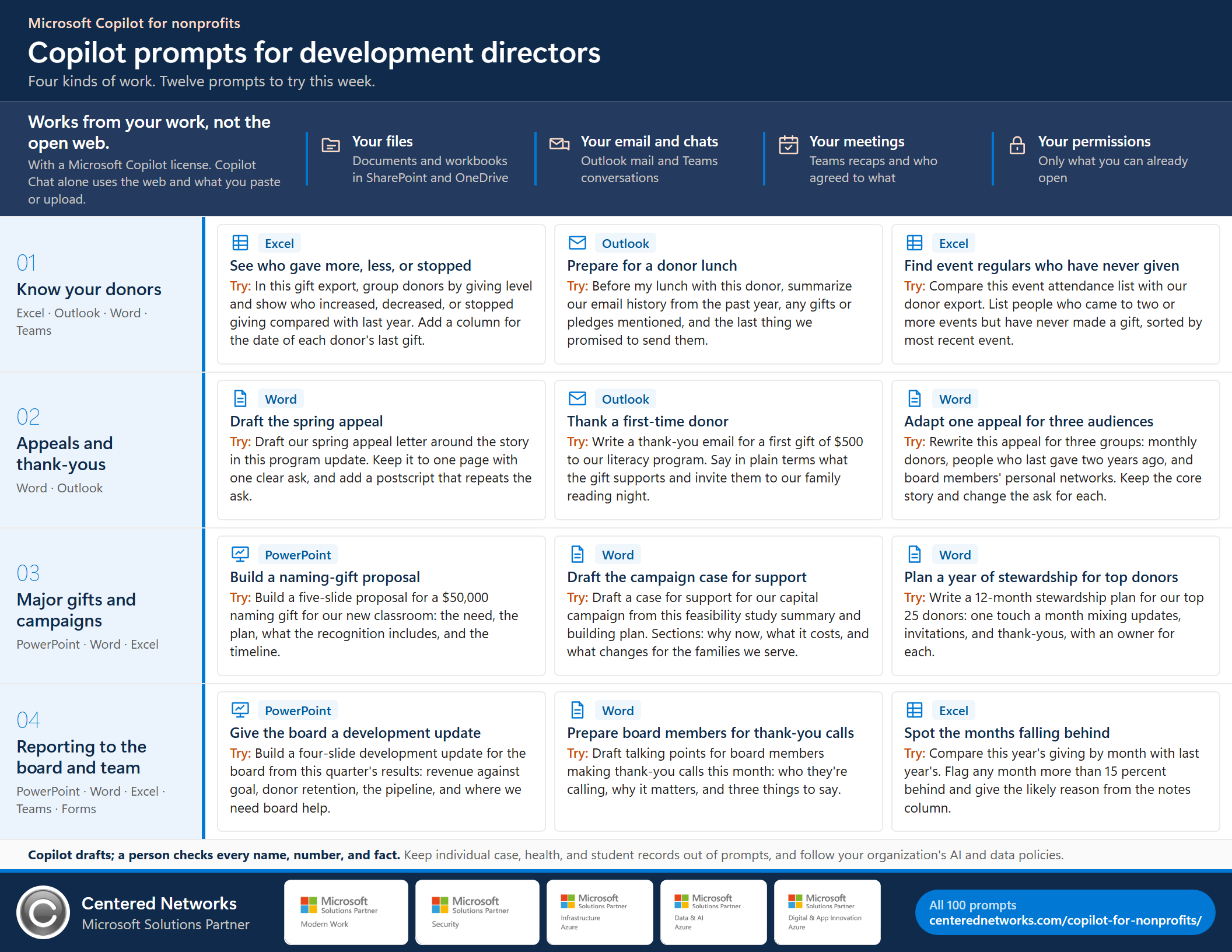
Copilot prompts for development directors, one page. Letter size, landscape. Share it with your team.
A note on data. These prompts work from documents, totals, and program-level information. Follow your organization's AI policy, and keep case notes, health information, and individual records out of prompts unless that policy says otherwise.
Your agent for this role
Start with Development Director by CN in Copilot Chat, then ground it in your own work.
Donor appeals, thank-you letters, and major-gift prep, drafted from what you paste in. It runs in the Copilot Chat that comes with Microsoft 365 and drafts only; it can't send, post, or submit anything. When you want it working from your own files, mail, and meetings, the next steps are Microsoft Copilot licenses with a governed pilot, a production agent built on your data, and Managed AgentOps to keep it accurate and in budget.
Beyond prompts
Want it to do the work, not just answer?
Prompts help one person at a time. We are building an AI operating system for nonprofits with founding partners: a governed team of role agents working on your organization's own Microsoft 365, so you get more done with the team you have.
The agents work from how your organization actually runs: funder history, deadlines, recurring work, and the reasons behind decisions. That knowledge stays with the organization when people leave. The executive director gets one approval inbox, every agent gets a scorecard, and nothing goes out until a person approves it.
Questions
Before you start.
Do I need a Microsoft Copilot license to use these prompts?
No, but the license changes what Copilot can see. Microsoft Copilot Chat is included at no extra cost for eligible Microsoft 365 work accounts; it works from the web and from what you paste or upload. A Microsoft Copilot license (formerly Microsoft 365 Copilot) lets Copilot work across the email, meetings, chats, and files you already have permission to open, and puts Copilot inside Word, Excel, PowerPoint, Outlook, and Teams. Prompts tagged Copilot app or Teams need the license to work from your own mail and meetings.
Is it safe to use Copilot with donor data?
Work from exports, segments, and totals your role already has access to, and follow your organization's AI policy. Licensed Microsoft Copilot reads only what you can already open and keeps your organization's existing permissions. Don't paste donor records into consumer AI apps that sit outside your Microsoft 365.
Will Copilot show me files I'm not supposed to see?
No. Copilot respects your existing Microsoft 365 permissions and only reads content you are already allowed to open. That also means it can surface a file that was shared too widely, so check your sharing settings before a broad rollout.
Does Copilot summarize Teams meetings automatically?
Meeting recaps need transcription turned on, and the full intelligent recap needs a Microsoft Copilot or Teams Premium license. Without them, paste or upload your own notes and ask Copilot to turn them into decisions and action items.
Can we share these prompts?
Yes. Centered Networks wrote them for nonprofit teams. Copy them, change the details to fit your work, and share the page or the one-page PDF.
Prompts for other roles
Sources for the Microsoft facts on this page
Checked on Microsoft Learn on October 13, 2026. Microsoft changes names, features, and licensing often; confirm in your Microsoft 365 admin center before you plan a rollout.
- Overview of Microsoft Copilot Chat (grounding, permissions, Chat versus licensed Copilot)
- Manage Microsoft Copilot Chat (eligibility, the 2026 name change)
- License options for Microsoft Copilot (web-based and work-based chat)
- Using agents in Microsoft Copilot Chat (which agents cost extra)
- Intelligent recap for Teams calls and meetings (license and transcription)
- Get started with Copilot Cowork (prerequisites)
- Manage Copilot Cowork for your organization (usage-based billing and limits)
All prompts on this page are written by Centered Networks. Copy them, adapt them, and share them with your team.